
Dunalley Primary School Learning and achieving together
Developing Executive Functioning
The Early Years are an important time for brain development. At Dunalley, we recognise the importance of developing the thinking skills that help children concentrate, remember information, plan, solve problems and manage their actions.
These skills are collectively known as executive functioning and play an important role in helping children become confident, independent and effective learners.
Building the brain through playful learning
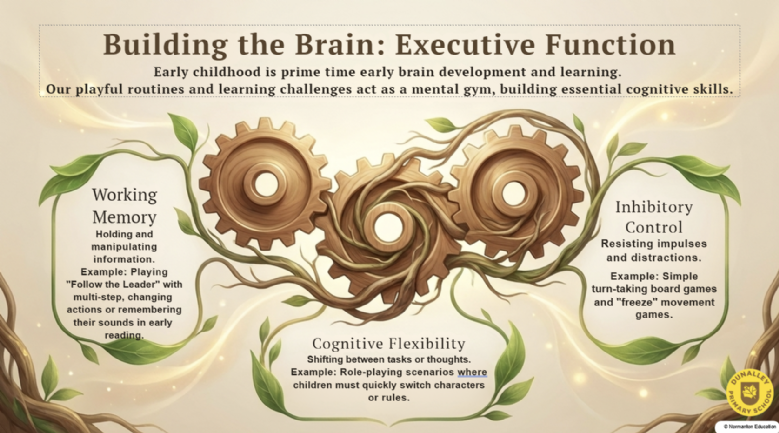
Our playful learning experiences, daily routines and carefully planned challenges provide opportunities for children to develop three key aspects of executive functioning.
Working Memory – Remembering and using information
Working memory helps children hold information in their minds and use it to complete an activity.
Children develop their working memory through experiences such as remembering the words and actions of songs and rhymes, following instructions, recalling familiar stories and remembering sounds when learning to read.
Cognitive Flexibility – Thinking flexibly and adapting to change
Cognitive flexibility helps children adapt their thinking, consider different possibilities and try alternative approaches.
Children develop this skill through experiences such as taking on different characters during imaginative play, adapting to changing rules in games and exploring different ways to solve a problem.
Inhibitory Control – Managing impulses and distractions
Inhibitory control helps children manage their actions, focus their attention and resist distractions.
Children develop this skill through experiences such as taking turns, playing board games and participating in movement games that involve stopping and starting.
Developing thinking skills through everyday experiences
Opportunities to develop executive functioning are carefully woven into our Early Years curriculum. Rather than teaching these skills separately, we help children develop them through purposeful play, everyday routines, practical experiences and learning challenges.
Through regular opportunities to practise these skills, children become increasingly able to concentrate, plan, persevere, adapt their thinking and manage their own learning.
Links to the Characteristics of Effective Learning
Executive functioning and the Characteristics of Effective Learning are closely connected.
The Characteristics of Effective Learning describe what we see children doing when they are learning effectively, whilst executive functioning describes the thinking skills that help make this possible.
For example, developing the ability to concentrate helps children remain engaged in their learning, whilst exploring different ways to solve a problem during play helps children develop flexible thinking.
Together, these skills and characteristics help children become increasingly confident, resilient and independent learners, establishing strong foundations for future learning.