Dunalley Primary School Learning and achieving together
Nursery & Pre-school Curriculum
Our school empowers all children to embrace learning, achieve their personal best and build their emotional,
social and physical wellbeing.
- We value each individual and celebrate diversity
- We care about each other and the environment
- We persevere and grow together
- We are ready, respectful and safe
Our Nursery and Pre-School Vision:
To cultivate a vibrant and nurturing early years environment where every child flourishes as a happy, confident, and independent learner. We aspire to ignite their natural curiosity about the world, empowering them to embrace challenges, take risks, and develop a resilient "can-do" attitude. Through rich experiences and strong partnerships, we aim to lay firm foundations for lifelong learning, positive relationships, and a deep understanding of themselves, their community, and the wider world.
Our early years curriculum is designed to foster:
- Happy and Confident Learners: We prioritise children's emotional and physical wellbeing and sense of belonging, creating a safe and supportive space where they feel valued, secure, and empowered to express themselves.
- Independent and Curious Minds: We encourage children to explore their interests, ask questions, and take ownership of their learning through open-ended activities and child-initiated play.
- A Fascination with the World: We provide stimulating experiences that spark curiosity about their immediate surroundings, the wider community, and the natural world, fostering a sense of wonder and inquiry.
- Resilience and a "Can-Do" Attitude: We create opportunities for children to experiment, problem-solve, and learn from their experiences, building their confidence to "have a go" and embrace challenges as part of their learning journey.
- Readiness for Future Learning: We equip children with the foundational skills, knowledge, and attitudes necessary for a successful transition to Reception and beyond, nurturing a lifelong love of learning.
- Understanding of Self, Community, and Environment: We promote self-awareness, empathy, and respect for others, alongside an understanding of their local community and the importance of caring for their environment.
- Wellbeing, Health, and Learning through Outdoor Experiences: We actively utilise our outdoor space as an integral part of our curriculum, providing rich opportunities for physical development, exploration, and connection with nature, contributing to their overall wellbeing and learning.
- Positive Relationships and Community Engagement: We foster strong relationships between children, staff, parents, and the wider community, recognising the vital role of partnership in supporting children's development and creating positive early school experiences.
- Active Involvement through Partnership: We actively seek and value the contributions of parents and carers, working collaboratively to ensure a holistic and supportive approach to each child's learning and development.
This curriculum intent will be brought to life through a playful curriculum approach, child-led approach, underpinned by the Early Years Foundation Stage (EYFS) framework and tailored to the unique needs and interests of our children. We are committed to providing a stimulating and inclusive environment where every child can thrive and reach their full potential.
Our provision is non-discriminatory, accessible and sensitive to race, gender, religion, culture, language, disability, sexuality and differing patterns of family life.
Principles
Overarching principles of the EYFS
There are four guiding principles that shape our practice in early years.
• Every child is a unique child, who is constantly learning and can be resilient, capable, confident and self-assured
• Children learn to be strong and independent through positive relationships
• Children learn and develop well in enabling environments with teaching and support from adults, who respond to their individual interests and needs and help them to build their learning over time. Children benefit from a strong partnership between practitioners and parents and/or carers
• Importance of learning and development. Children develop and learn at different rates.
EYFS Framework (2023)
Our Curriculum Principles

Childhood
At Dunalley, providing a positive environment and education, which values and nurtures the whole child is pivotal to our pedagogical approach and is our driver principle. We champion a happy, safe and holistic approach to childhood. We value childhood as a progressive learning state, as well as preparation for our children’s readiness for their next stage. Learning and environments are tailored to meet the ages, stages and needs for our learners to grow and thrive.
Expressive communication
Expressive communication is about empowering children to be able to develop and express their identity through confidently communicating. Expressive communicators have a voice to express their own thoughts, feelings, interests and ideas to make meaning. Adults support children to develop the vocabulary and language, as well as the confidence and willingness to communicate with others.
Relationships
Relationships are of central importance in a child’s life and social interaction with peers and adults, modelling and learning from each other is fundamental. Relationships with families and wider networks are valued as critical partners in children’s development and learning.
Nature and outdoors
Championing the importance of spending time outdoors and interacting with the natural world is crucial for childhood development, health and wellbeing.
Power of play
Play is the foundation of learning and the most essential way for children to learn and develop. Through play, children explore, experiment, and make sense of the world around them. Through a ‘playful continuum,’ adults offer a stimulating and nurturing environment which allows children to explore, be curious and learn independently, whilst modelling and scaffolding learning to support developing knowledge.
Connection and unity
Children see encouraged to know and value the connections between different subjects, between themselves and others, and between themselves, nature and the wider world.
Independent and autonomous
Children learn best by doing things themselves, becoming aware of their learning and by reflecting. To be independent children grow in confidence, their ability to be resilient, critically think, emotionally regulate and apply a ‘can do’ attitude.
Knowledgeable and nurturing adults
Underpinning the principles are knowledgeable and nurturing adults. Adults provide a nurturing and stimulating environment but also allow children the freedom to explore and learn independently. The role of the educator is to observe, guide, and support children's learning. We value external adults who are specialists who contribute to our learning community to support our children, practitioners and families.
Our curriculum rationale
We believe that a blend of Froebelian and Constructivist pedagogical principles provides the optimal framework for our nursery and pre-school for the following reasons:
- Our pedagogy views children as active constructors of their own knowledge. Frobels’ ‘children as seeds’ approach highlights the importance of providing the right environment for natural growth and development. This aligns perfectly with our commitment to valuing each child's individual interests, learning styles, and pace.
- We foster and prioritise active involvement in the learning process. Children learn best when they are actively engaged in exploring, experimenting, and constructing their own meaning. Our curriculum is rich in practical activities, investigations, and opportunities for children to learn through first-hand experience. This fosters deeper understanding and greater engagement.
- We recognise the social nature of learning. Children learn from and with each other through collaboration, discussion, and sharing ideas. Our nursery and pre-school environments foster a sense of community and provides opportunities for children to learn collaboratively.
- We emphasise the value of outdoor learning and direct experience with the natural world. Connecting learning to real-world experiences and natural environments helps children to see the relevance of what they are learning and build deeper understanding. Our nursery utilises outdoor spaces and natural materials to facilitate this connection.
Building foundational knowledge through the curriculum
Our curriculum is planned towards building foundational knowledge needed to support strong early development and provide the blocks on which future experiences and learning can build. This progressive knowledge-rich approach, when applied across all areas of learning in the early years’ curriculum, provides a holistic and robust foundation that significantly supports children's development and smooth transition into Reception and Year 1.
A well-designed and implemented progressive early years curriculum acts as a carefully constructed staircase, with each step building upon the last. This ensures that children develop a broad range of skills, knowledge, and positive learning dispositions that are essential for navigating the academic and social landscape of Reception and Year 1, setting them on a positive trajectory for their future learning journey.
We therefore identify in our curriculum:
Substantive Knowledge (The 'What' and ‘How’ – Core content and Concepts)
This is the core knowledge children need to acquire including vocabulary and language, concepts and processes such as knowledge of how they do something for example, how to form a tripod grip, or where they live.
Disciplinary Knowledge (The 'When' and ‘Why’ – ‘Skills’ and Processes):
For an early learner, disciplinary knowledge is about developing an implicit and then increasingly explicit understanding of:
- When to engage in a particular way of thinking or acting: Recognising the cues, contexts, and situations that call for specific approaches.
- Why a particular way of thinking or acting is appropriate or effective in that discipline: Understanding the underlying purpose, goals, and conventions of different areas of learning.
It's about building foundational awareness of how different "disciplines" (in their early years form) function that will support them to become authors, mathematicians, scientists, gardeners, historians, astronauts or even artists in the future.
Knowledge Progression
Creating a progressive knowledge-based curriculum supports our children’s holistic development across the AOLS:
- Personal, Social and Emotional Development (PSED): Progressively building self-regulation, managing feelings, forming relationships, and developing confidence in nursery directly impacts how children adapt to the social and emotional demands of Reception and Year 1. They are more likely to be resilient, independent learners who can collaborate with peers and engage positively with adults.
- Physical Development: Gradual development of gross and fine motor skills, coordination, and body awareness in nursery prepares children for the physical tasks required in later schooling, such as writing, using tools, participating in PE, and managing their belongings.
- Literacy: As discussed before, a progressive approach to phonological awareness, early mark-making, and exposure to books in nursery lays the groundwork for formal reading and writing instruction in Reception and Year 1.
- Mathematics: Progressively developing number sense, understanding shape, space, and measure in the early years provides the foundational concepts for more formal mathematical learning in later years. Children who have explored these concepts through play and practical activities have a stronger intuitive understanding.
- Understanding the World: Gradually building knowledge about the natural world, people and communities, and technology in nursery fosters curiosity and a basic understanding that can be built upon in the more structured learning of Reception and Year 1. It helps them make connections to new information and develop a broader worldview.
- Expressive Arts and Design: Progressively exploring different materials, techniques, and media in nursery supports creativity, imagination, and self-expression. This foundation encourages engagement with art, music, drama, and dance in later schooling, fostering a well-rounded development.
2. Developing Essential Learning Skills:
- Curiosity and Exploration: A progressive curriculum encourages children to ask questions, investigate, and explore their environment at each stage. This intrinsic motivation for learning is crucial for engaging with the more structured curriculum in Reception and Year 1.
- Problem-Solving: Gradually introducing challenges and encouraging children to find solutions in nursery fosters early problem-solving skills that are essential for academic success in later years.
- Critical Thinking: While in its early stages, a progressive approach encourages children to make simple comparisons, notice patterns, and begin to form their own ideas, laying the foundation for more complex critical thinking skills in Reception and Year 1.
- Persistence and Resilience: As children are supported to try new things and overcome small challenges in a nurturing nursery environment, they develop resilience and a willingness to persevere when faced with difficulties in later schooling.
- Self-Regulation: Progressive support in managing their own behaviour, understanding routines, and focusing their attention in nursery helps children adapt to the more structured environment and expectations of Reception and Year 1.
3. Fostering a Positive Attitude Towards Learning:
- Engagement and Motivation: A well-planned, progressive curriculum that builds on children's interests and abilities keeps them engaged and motivated to learn from an early age. This positive attitude towards learning is a significant predictor of success in later schooling.
- Confidence and Self-Esteem: As children experience success and see their skills and knowledge develop over time in nursery, their confidence and self-esteem grow. This positive self-image supports their willingness to take risks and embrace new learning opportunities in Reception and Year 1.
4. Supporting a Smooth Transition:
- Familiarity with Learning Processes: A progressive approach introduces children to the processes of learning – observing, questioning, experimenting, reflecting – in a developmentally appropriate way. This familiarity makes the transition to the more formal learning structures of Reception and Year 1 less daunting.
- Building Foundational Knowledge: By systematically building knowledge and skills across all areas, children enter Reception and Year 1 with a stronger base upon which teachers can build more complex learning. This reduces potential gaps in understanding and allows for more effective teaching.
A playful curriculum
At Dunalley, the curriculum is designed to recognise children’s prior learning and to provide first hand learning experiences. Stated within the EYFS framework (2021), ‘Play is essential for children’s development, building their confidence as they learn to explore, relate to others, set their own goals and solve problems. Children learn by leading their own play, and by taking part in play which is guided by adults.’
Children learning through play is the key thread throughout our curriculum. We understand that as children develop, the playful curriculum adapts to their age and stage.
“Both play-based learning and direct instruction have value for teaching young children, but considering which is better suited to a particular form of knowledge is crucial. It is also important to think about how best children can learn what is intended.” - Ofsted Strong Foundations (2024)
“Given the evidence of the benefits of play and direct instructions, educators should incorporate both practices.” - Managhan
"Play is the highest expression of human development in childhood, for it alone is the free expression of what is in a child's soul." - Friedrich Froebe
We embrace a playful learning approach at Dunalley.
This means, within our Early Years, we embrace learning experiences which are:
Active: Children are actively involved and mentally engaged in the learning process, rather than passively receiving information.
Engaging: The experience captures and maintains children's interest and curiosity.
Meaningful: Learning is connected to children's prior knowledge, experiences, and interests, making it relevant and understandable.
Socially Interactive: Play often involves interaction with others, fostering communication, collaboration, and social skills.
Iterative: Play allows for repetition, experimentation, and trying out different ideas, leading to deeper understanding through cycles of action and reflection.
Joyful: Play is inherently enjoyable and creates positive emotions, which enhance motivation and learning.
Curriculum guidance for the Foundation Stage suggests that children learn in two major ways:
- When they play freely in well-resources environments, with adults sometimes intervening sensitively.
- When adults show children how to do things by modelling.
“This means that we need a wide-ranging pedagogical repertoire. Sometimes it is important to let children initiate their own play freely. But we also need to be mindful that children’s play can become quite repetitive, without sensitive intervention from adults…practitioners need to introduce them to new experiences and vocabulary.” Julian Grenier
To ensure meaningful learning, building of experiences and vocabulary through playful approaches within our curriculum, we apply a continuum of playful learning.
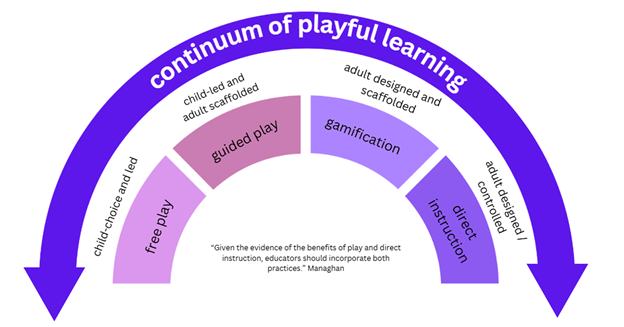
Key aspects of such a playful continuum curriculum includes:
- Child-Initiated/Free Play: Children have complete autonomy over their play – the ideas, materials, and direction. Adults observe and may provide resources but do not direct the play. Learning emerges naturally from the child's exploration and interests.
- Guided Play: Adults play a more active role in setting the stage for play and may introduce specific materials or challenges related to learning goals. However, children still have significant agency in how they engage with the play and solve problems. Adults might ask open-ended questions, offer suggestions, or model skills within the context of the play.
- Playful Learning Activities/Games with Rules: These activities are more adult-directed, with specific learning objectives and ‘rules.’ However, they still incorporate elements of fun, engagement, and often social interaction to enhance learning. These are based on gamification theory.
- Direct Instruction (with playful elements): While primarily adult-led, this end of the spectrum incorporates playful strategies (like games, songs, or role-play) to make learning more engaging and memorable. For our youngest children this might be circle time, singing songs and rhymes, through to sessions such as phonics as children get older in pre-school and reception.
The role of educators in the Early Years
Respecting diverse perspectives, expectations, and values forms the bedrock of strong partnerships. When educators collaborate meaningfully with children, families, other professionals, and community resources, including schools, they harness collective knowledge and skills, making the achievement of learning outcomes far more probable.
In genuine partnerships educators:
- value and respect each other’s knowledge of each child.
- value and respect each other’s contributions to and roles in each child’s life.
- build trust in each other.
- act with empathy and sensitivity when children are experiencing adversity.
- learn about other ways of knowing, being, doing and thinking as an early year practitioner.
- communicate and share information safely and respectfully with each other.
- share insights and perspectives about each child with families.
- acknowledge the diversity of families and their aspirations for their children.
- engage in shared decision-making to support children’s learning, development and wellbeing.
- engage in research and evidence-based practice to improve the quality of provision and of own knowledge and confidence.
Our curriculum
Our intent is to create an EYFS curriculum that captivates and engages every child from their very first day, providing a rich tapestry of learning woven into every moment of their school experience.
We aim to empower them with the essential skills and knowledge that will serve as a strong springboard for their future learning. In our positive, caring, and welcoming environment, nurtured by a dedicated team, children feel secure, valued, and inspired to achieve their best.
Inclusivity is paramount; we encourage all children to develop empathy and consider the needs of others. We deeply respect and value parents and carers as their children's primary educators, actively building strong partnerships and offering meaningful ways for them to participate in their child's learning journey, both at school and at home.
We are committed to providing unwavering support for the holistic well-being of each child, recognising that their physical and emotional needs are fundamental to their success.
Celebrating individuality, our curriculum acknowledges and responds to the unique learning requirements and developmental pace of every child. Our skilled practitioners deliver a wide array of stimulating, thought-provoking, and challenging experiences, fostering the development of skills and knowledge.
We intentionally weave British fundamental values and cultural capital into our diverse learning opportunities.
Initially, we prioritise the development of strong foundations in the prime areas of learning, enabling children to confidently build upon this base and explore more complex skills, processes and knowledge within the specific areas.
Areas of learning
The revised EYFS has seven areas of learning:
Three Prime Areas
- Personal Social and Emotional Development
- Communication and Language
- Physical Development
These three areas are our main focus in our Under 3s room, as the knowledge and skills are fundamental for our children and the starting point for all other areas of learning.
Four Specific Areas
- Literacy
- Mathematics
- Understanding the World
- Expressive Arts and Design
Characteristics of Effective Learning
Threaded through all the areas of learning, children will be using the Characteristics of Effective Learning.
- Playing and Exploring - children investigate and experience things, and ‘have a go.’
- Active Learning - children concentrate and keep on trying if they encounter difficulties and enjoy achievements.
- Creating and thinking critically - children have and develop their own ideas, make links between ideas, and develop strategies for doing things.
These characteristics will underpin a child’s learning and development and will help a child to remain an effective and motivated life-long learner.
We also pay attention to developing early executive function. This refers to a set of cognitive skills that are essential for goal-directed behaviour and self-control. Executive functions are the mental processes that enable us to plan, focus attention, remember instructions, and juggle multiple tasks successfully.
The core components of executive function are:
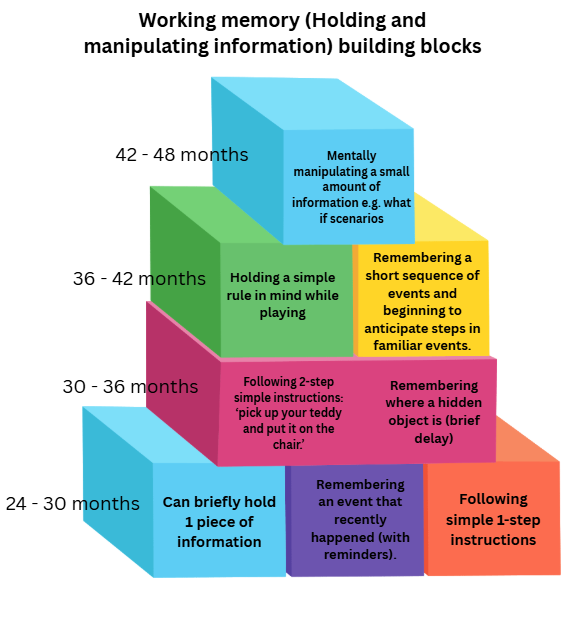
- Working Memory: Holding and manipulating information in mind.
- Cognitive Flexibility: Being able to switch between different thoughts or tasks.
- Inhibitory Control: The ability to resist impulses and distractions.
Developing strong executive function skills underpins a child's ability to demonstrate the Characteristics of Learning effectively. For example, a child with good, sustained attention (an aspect of EF) will be better able to engage in active learning.
Conversely, when children are encouraged to play and explore, actively learn, and think critically, they are practicing and developing their executive function skills. For instance, problem-solving during play helps to build cognitive flexibility.
In essence:
- The Characteristics of Learning describe the outward behaviours of a child who is learning effectively.
- Executive Function describes the internal cognitive skills that make those effective learning behaviours possible.
“The early years are prime time for growth because the brain’s frontal lobe, which handles much of executive function, is rapidly developing. This is the best time to gently exercise these mental “muscles”. It’s similar to how young children easily absorb language – they can also readily pick up habits of thinking that underpin self-regulation and problem-solving. Importantly, executive function skills emerge through practice and experiences." Schmalaker (2025)
Executive functioning building blocks: milestones
These building blocks support our childhood principle, by preparing children for their next steps and transitions. Our staff plan opportunities into the curriculum, environment and provision, which actively encourage these developmental building blocks. Executive functioning development is not necessarily linear and so being aware of the developmental blocks is useful.