
Dunalley Primary School Learning and achieving together
Year 6 Curriculum Summer 2026
YEAR 6 SUMMER TERM
The year is flying by and the final term of Year 6 is upon us. The children have continued to make progress in their learning during the spring term, and as SATs assessments in May rapidly approach, we are proud of the enormous effort and positive attitudes to learning and one another they have displayed so far.
SATs week dates
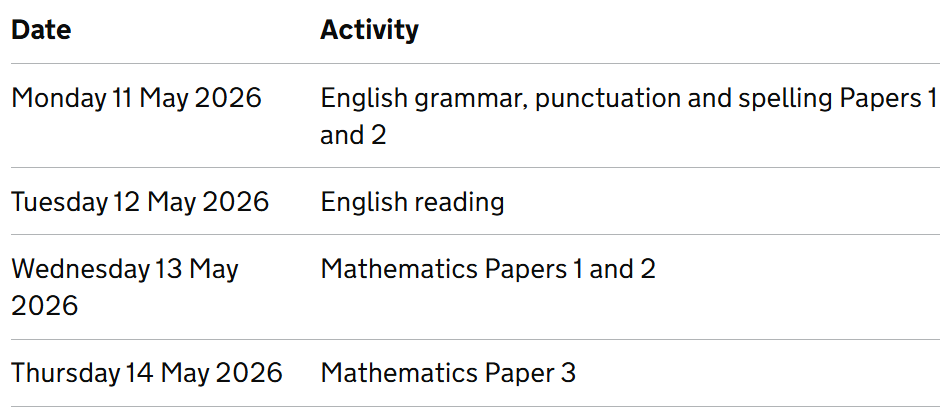
If your child is absent during this week, they will complete the paper(s) missed on their return.
Once again, we will be inviting children to attend breakfast during SATs week. Running from 8am, toast and cereal will be provided free of charge. These breakfasts provide a calm start to the day, enabling the children to relax and enjoy each other’s company before switching into the focused mindset needed to achieve their very best in the assessments.
WRITING
During the summer term, we will continue to work on a range of writing features and genres as we compile a final selection of assessment pieces. Future pieces will be linked to our learning across the curriculum, including non-chronological reports about animals and the poem The Highwayman by Alfred Noyes. Spelling and grammar will continue to be taught in context within our English lessons. Please continue to help your child learn the relevant spelling lists provided and complete any spelling, punctuation and grammar homework set.
GUIDED READING
Guided reading will continue to cover fiction, non-fiction and poetry and will be supported by our class novel High-Rise Mystery by Sharna Jackson. Please continue to support your child’s reading by ensuring that they read at least 5 times per week.
MATHS
With our units of work now complete, we will continue to develop and deepen children’s understanding of the maths taught this year as well as have a focus on problem-solving. This learning will help prepare the children for the challenges of the curriculum at secondary school.
SCIENCE
During this term, the children will be learning about evolution and inheritance. Later in the term, we will be covering the human circulatory system and how leading a healthy lifestyle has an impact on how our bodies function.
HISTORY
Across the entire summer term, the children will be learning about the Stone Age, Bronze Age and Iron Age. They will learn how our understanding of prehistory is constructed from limited sources and they will appreciate the changes in technology that enabled people, specifically within Britain, to transition from a hunter-gather society to settled communities based around farming.
The children will revisit the watercolour painting skills developed during the autumn term to produce images of the animals they have selected for their non-chronological reports. These will be used to create in our own class versions of the book Beautiful – A Celebration of Evolution by William Spring.
DT
The children will be designing, making and evaluating a textile mobile phone case. They will be taught to use a range of stitches and fastening techniques to make a product that is fit for purpose based on a simple design specification. At the end of the term, the children will be making pizzas.
COMPUTING
This term, the children will explore the concept of variables in programming through games in Scratch. After half term the children will use computers to learn about 3D modelling. Later, the children will also use a micro:bit to design, write, and debug programs that accomplish specific goals, including controlling or simulating physical systems. Online safety will continue to be taught, including a focus on ownership and copyright.
RE
During the summer term, the children will be finishing the previous unit on Islam and the next unit considers ‘How might someone’s world view affect how they view and treat the natural world?’.
PHYSICAL EDUCATION (PE)
PE will take place on Mondays (dance) and Tuesdays (athletics) for 6NJ and Tuesdays (athletics) and Fridays (dance) for 6LJ. In the second half of the summer term, we will focus on cricket and golf.
FRENCH
The children will be learning about school and developing their verbal skills as well as reading and writing in French.
MUSIC
After half-term, the children will learn a range of popular songs linked to our end-of-term assembly.
PSHE
The focus for this half-term is ‘Healthy Me’. After the half-term break, children will be finding out more about puberty and reproduction during Health Week. We will also work on skills to support the children in their transition to secondary school.
HOMEWORK
Homework is set for Wednesday, and we expect it to be handed in on the following Wednesday.
YEAR 6 LEAVERS CELEBRATION – AFTERNOON OF WEDNESDAY 15th JULY
Please save this date as we are looking forward to welcoming families