
Dunalley Primary School Learning and achieving together
Building Foundational Knowledge
Our Early Years curriculum is carefully planned to develop the foundational knowledge that children need to support their early development and provide the building blocks for future learning.
The Knowledge Staircase
We think of our curriculum as a carefully constructed staircase, with each step building upon the last.
From Nursery through Pre-school and Reception, children build upon what they already know and can do, developing new knowledge, vocabulary, skills and understanding. We provide opportunities for children to revisit their learning, make connections and apply what they know in different situations.
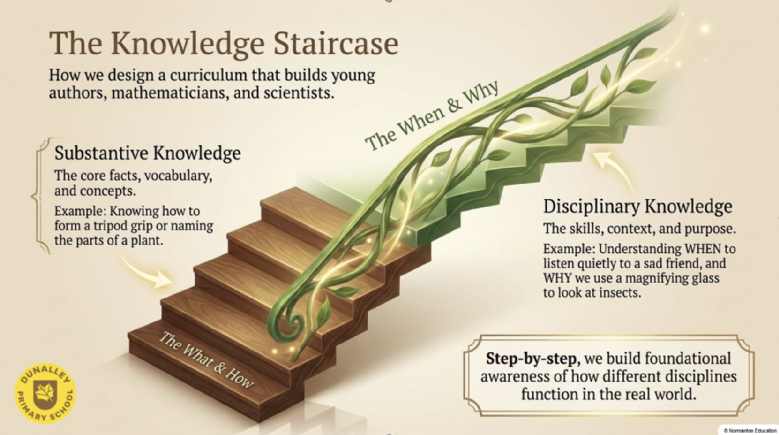
Within our curriculum, we identify two interconnected types of knowledge.
BIG KNOWLEDGE – Substantive Knowledge
Knowing what and how
This is the important knowledge, vocabulary and skills that children acquire as they learn about themselves and the world around them.
For example:
-
Knowing the names of different parts of a plant.
-
Knowing how to count a group of objects.
-
Knowing words to describe their feelings.
-
Knowing how to mix colours.
-
Knowing how to hold and use a pencil.
KNOWLEDGE 'TO BE LIKE' – Disciplinary Knowledge
Understanding when and why
This is about helping children understand when and why they might use their knowledge. We encourage children to begin to think and act like mathematicians, scientists, authors, artists and historians.
For example:
-
Thinking like a mathematician by recognising when counting will help them find out how many objects there are.
-
Thinking like a scientist by using a magnifying glass to observe an insect more closely.
-
Thinking like an artist by experimenting with colours and materials to express an idea.
-
Thinking like a historian by exploring photographs to discover how things have changed over time.
Bringing knowledge to life
Through purposeful play, practical experiences, exploration and high-quality interactions, we help children make connections between what they know and how they can use that knowledge.
Our aim is for children not only to know and remember more, but also to understand and apply their learning with increasing confidence and independence.