
Dunalley Primary School Learning and achieving together
Our Curriculum Principles
Our Early Years curriculum is underpinned by eight interconnected principles that reflect our beliefs about childhood, learning and development.
These principles shape our curriculum, our learning environments, the experiences we provide and the ways in which our practitioners interact with and support children.
Childhood is our driver principle, with seven supporting principles that work together to provide the conditions in which every child can grow and thrive.
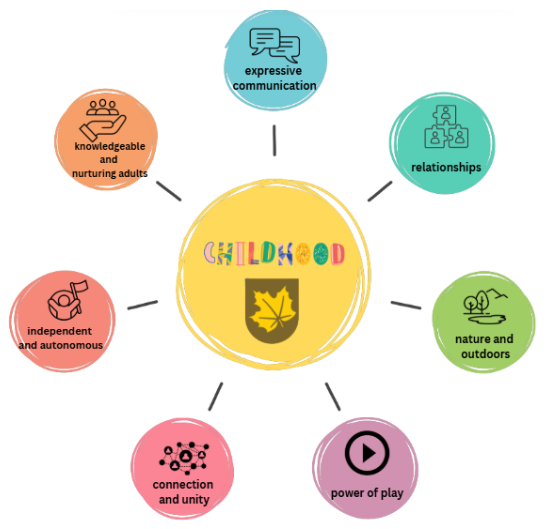
Childhood
At Dunalley, providing a positive environment and education that values and nurtures the whole child is central to our approach.
We champion a happy, safe and holistic approach to childhood, recognising its importance as a stage of life in its own right, as well as providing the foundations for children's future learning and development.
Our learning experiences and environments are tailored to meet children's ages, stages of development and individual needs, enabling them to grow and thrive.
Expressive communication
We empower children to develop and express their identity through confident communication.
We want every child to have a voice through which they can express their thoughts, feelings, interests and ideas, make meaning and connect with others.
Our practitioners support children to develop the vocabulary, language, confidence and willingness to communicate in a range of contexts and ways.
Relationships
Relationships are of central importance in children's lives and underpin their learning, development and wellbeing.
Social interactions with peers and adults, modelling and opportunities to learn from and with one another are fundamental to our approach.
We value relationships with families and wider networks, recognising them as important partners in children's learning and development.
Nature and outdoors
We champion the importance of spending time outdoors and interacting with the natural world, recognising the significant benefits for children's development, health and wellbeing.
Our outdoor environments provide rich opportunities for children to explore, investigate, develop their physical skills, embrace challenges and experience the wonder of the natural world.
Through these experiences, children develop an appreciation of nature and an understanding of the importance of caring for our environment.
Power of play
Play is fundamental to children's learning and development.
Through play, children explore, experiment, develop ideas, make connections and make sense of the world around them.
Through our continuum of playful learning, practitioners provide stimulating and nurturing environments that enable children to explore, be curious and learn independently, whilst modelling, guiding and supporting the development of knowledge and skills.
Connection and unity
We encourage children to recognise and value the connections between different areas of learning, between themselves and others, and between themselves, nature and the wider world.
Through meaningful experiences, children build upon their existing knowledge, make connections between ideas and develop an increasingly rich understanding of the world around them.
We nurture a sense of belonging and encourage children to recognise their place within their family, school, community and the wider world.
Independence and autonomy
We recognise the importance of children having opportunities to do things for themselves, make choices, become aware of their own learning and reflect on their experiences.
Through carefully planned opportunities and appropriate support, children grow in confidence, develop resilience, think critically, regulate their emotions and develop a positive 'can-do' attitude.
We encourage children to embrace challenges, persevere, solve problems and take increasing ownership of their learning.
Knowledgeable and nurturing adults
Knowledgeable and nurturing adults underpin all our curriculum principles.
Our practitioners provide stimulating, supportive and nurturing environments, whilst allowing children the freedom to explore, investigate and learn independently.
They carefully consider when to observe, when to guide, when to model, when to explicitly teach and when to provide additional support or challenge.
Through positive relationships and high-quality interactions, practitioners respond to children's interests, strengths and needs, helping them to develop their knowledge, understanding and independence.
We also value the contribution of external specialists who enrich our learning community and support our children, practitioners and families.